
SPECTRAL EVIDENCE
Between the 17th and 19th centuries, spectral evidence was frequently given as witness testimony in court proceedings. Spectral evidence was usually comprised of two corresponding ideas. The first is that the spectral shape/spirit of the accused would leave their physical living body, through witchcraft, to interact with the living to complete a nefarious objective, usually through torment. Living in New England, when someone hears the term spectral evidence, they automatically associate it with the infamous Salem witch trials of 1692. During that dark event, nineteen people were hanged on Proctor’s Ledge, five died in jail, and Giles Corey, a prosperous land-owning farmer, was subjected to a method of torture called peine forte et dure in which he was ultimately pressed to death.
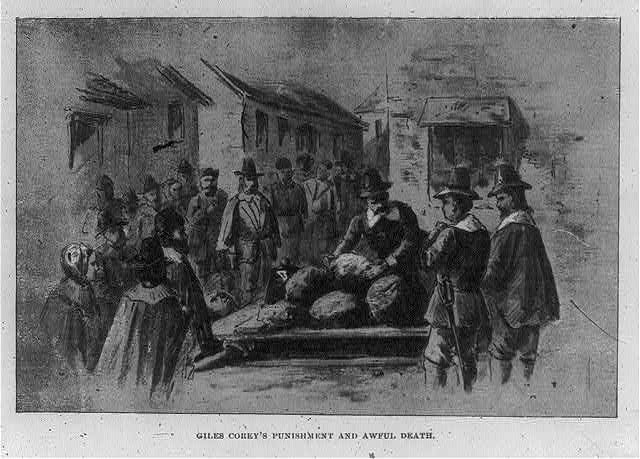
Image courtesy of Library of Congress
IMAGE LINK
Spectral evidence played a pivotal role in the indictment of several accused witches. It was overwhelmingly relied on during the trial of Bridget Bishop, who was the first to be found guilty and hanged during the hysteria. According to Cotton Mather in his work, The Wonders of the Invisible World, the bewitched testified, “That the Shape of the Prisoner did oftentimes very grievously Pinch them, Choak them, Bite them, and Afflict them; urging them to write their Names in a Book, which the said Spectre called, Ours.”[1]

Image courtesy of The University of Virginia.
See citation 1 for image source reference.
The second idea is that the spirit of a deceased victim visits the realm of the living, usually through dreams, to pass on a message or to complete unfinished business. Nearly two decades before the Salem witch trials, on the night of February 8, 1673, Rebecca Cornell was found dead in her chamber on a Portsmouth, Rhode Island farm that she shared with her son Thomas, his wife Sarah, and their children. Edward, her grandson, discovered the fire in her room while inquiring if his grandmother wanted anything to eat. The 73-year-old’s body was burnt beyond recognition, and it wasn’t until her son Thomas took a closer look that he saw the remains were of his mother. Initially, the coroner believed that the cause of death was accidental. However, a few days later, on February 20, Rebecca’s brother, John Briggs, went to the authorities with a fantastic tale. He believed that on February 12, two days after Rebecca’s funeral, her spirit had visited him from the other side. The apparition said, “I am your sister Cornell,” and “see how I was Burnt with fire” twice.[2] After this, her body was exhumed. A second inquest yielded that Rebecca died of burns and a wound near her heart. Thomas Cornell, her son, was promptly taken into custody. Due to the spectral testimony given by Briggs and other assorted, highly circumstantial bits of evidence, he was found guilty and sentenced to hang.
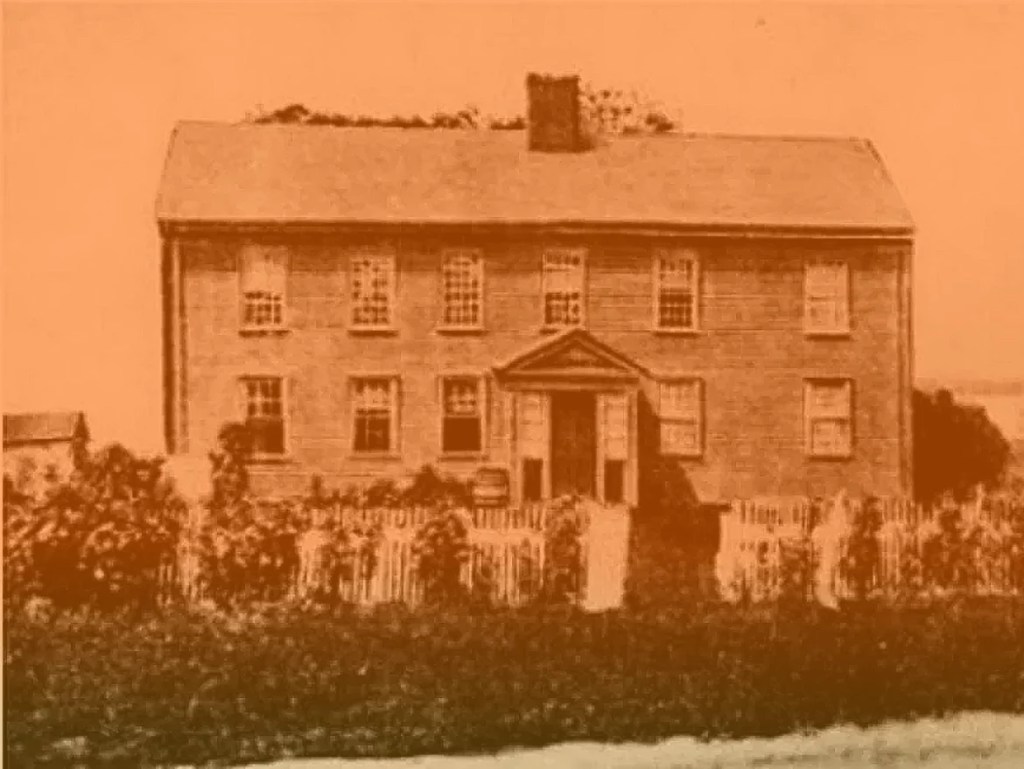
Image courtesy of the New England Historical Society
IMAGE LINK
Spectral evidence was not strictly a phenomenon exclusive to 17th-century Puritan New England. Between January 22 and 23, 1897 (the date differs in numerous primary sources), Elva Zona Heaster Shue was found dead by 11-year-old Andy Jones, a neighbor, at the bottom of the stairs in her Lewisburg, West Virginia log house.

Public domain image.
IMAGE LINK
Elva shared the home with her husband of three months, E.S. “Trout” Shue. Dr. George W. Knapp initially determined her death as “death by heart disease,” and her body was hastily buried.[3] After a few weeks, her body was exhumed, a second post-mortem examination was conducted, and her neck was found to be broken. The catalyst for this second inquiry was due to “suspicious conducts and conversations” with E.S. Shue and evidence that Elva’s mother brought to authorities.[4] Mary J. Heaster, Elva’s mother, was said to have had visions and dreams of her deceased daughter; it was reported in the July 5, 1897 edition of the Baltimore American that, “The principal evidence was of Shue’s mother-in-law, who testified that her daughter’s spirit had come to her at a séance and said Shue had killed her by breaking her neck.”[5] She told the prosecutor in court that “she came back and told me that he was mad that she didn’t have no meat cooked for supper. […] She cames [sic] four times, and four nights; but the second night she told me that her neck was squeezed off at the first joint and it was as she told me.”[6] E.S. “Trout” Shue was found guilty of the murder of his wife and sentenced to life in prison, where he would die in March 1900.

Image courtesy of the Baltimore American, via Google News Archive Search
IMAGE LINK
CITATIONS:
[1] Cotton Mather, The Wonders of the Invisible World (Boston, 1693), p. 66, The Wonders of the Invisible World (virginia.edu).
[2] Elaine Forman Crane, Killed Strangely: The Death of Rebecca Cornell (Ithaca: Cornell University Press, 2002), p. 19.
[3] “Mother-in-law’s Vision as Evidence,” Baltimore American and Commercial Advertiser, July 5, 1897, 5, Baltimore American – Google News Archive Search.
[4] West Virginia Archives & History, “The Shue Murder Trial in Greenbrier,” The Greenbrier Ghost, West Virginia Department of Arts, Culture and History, last accessed January 9, 2024,The Greenbrier Ghost (wvculture.org).
[5] “Mother-in-law’s Vision as Evidence,” Baltimore American and Commercial Advertiser, July 5, 1897, 5, Baltimore American – Google News Archive Search.
[6] West Virginia Archives & History, “Mrs. Mary J. Heaster, the Mother of Mrs. Shue, Sees her Daughter in Visions,” The Greenbrier Ghost, West Virginia Department of Arts, Culture and History, last accessed January 9, 2024,The Greenbrier Ghost (wvculture.org).
 The Ghastly Historian


One response to “1/9/2024: Spectral Evidence”
[…] with my latest Ghastly History blog post! It was released last month – you can check it out here. The post discusses a few cases involving spectral evidence. Also, be sure to check out the Ghastly […]
LikeLike