
HERMIT OF THE TOMB
Even in death, Jonathan Reed expressed his unwavering devotion to his wife, Mary Guild Reed, and vowed not to leave her side. A once successful entrepreneur of the trucking business from the New York borough of Brooklyn, he later became known as a local, much talked about eccentric, and dubbed “the hermit of the tomb” in the media. Reed believed it was his duty to care for his wife even after her passing in March 1893. In the Buffalo Sunday News in October 1903, he recounted to the newspaper that on his wife’s deathbed, he told her, “I shall always be by your side. I will keep you from the mud and from the clay. […] I told her of my plans to do just what I am doing now; that I would build a beautiful tomb and sit by her side every day.”[1] After her death, Reed purchased a plot in the Whispering Oaks section of Evergreens Cemetery in Brooklyn, New York. There, he oversaw the construction of a two-room stone crypt that extended into a high embankment surmounted by a large granite ball. After its completion, Mr. Reed had Mary’s body exhumed, which had previously rested in an expensive metallic casket in her father’s crypt for some time, and moved to the newly erected structure.
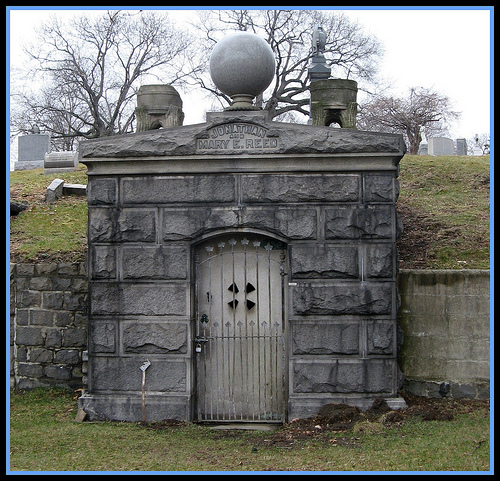
Jonathan and Mary E. Reed mausoleum.
Image courtesy of user BKGeni via FindaGrave.com.
IMAGE LINK
By this time, Mr. Jonathan Reed, whom the Brooklyn Daily Eagle described as “an unusually intelligent and interesting man […] [who] converses upon all subjects with a degree of knowledge and insight rare to persons of his age,” had begun his more than decade-long vigil at the tomb.[2] Even though many of his close friends tried to convince him that Mary was dead, he believed she merely had a condition that the warmth had just left her body, and he would ensure that she would sleep comfortably. The New York Times wrote, “The Reed mausoleum was furnished just like a living room in a fine house, all the usual articles of furniture being provided. It was warmed with a fine oil stove manufactured specially for the tomb.”[3] Mr. Reed would arrive at the mausoleum when the cemetery gates opened at 6:00 AM and remain until the gates closed at 6:00 PM. During the summer, he would plant and care for the flowers around his wife’s resting place; during the winter, he would shovel a path leading to the tomb so it would be clear of snow. He would have all his meals at the location and would be known for having conversations with his wife. During this time, he welcomed many visitors and invited them to view the tomb while conversing with all who came to see the largely media-precipitated spectacle for themselves. In many accounts, it was said that the Reeds had 7,000 visitors to the site in the first year, including people from all over the world. It was also reported that seven Buddhist monks from Burma thought Mr. Reed knew life after death.

Image courtesy of The Buffalo Sunday News via Newspapers.com
IMAGE LINK
After many years of faithful devotion to his wife, Jonathan Reed was found close to death by a laborer lying on the stone floor of the tomb in March 1905. He suffered a stroke and was brought to the Kings County Hospital and placed in the pauper’s ward. Mr. Reed recovered enough to be eventually discharged and placed in the home of his niece in Valley Falls, New York. However, he would soon develop paralysis and placed in a private sanitarium near Troy, New York, where he passed away on September 12, 1905, at the age of 72. Two days later, a brief funeral was held where they transferred Mr. Reed’s body from a wooden casket to a metallic one, which he had procured and left in the tomb. The crypt was locked, and a single key was kept by cemetery personnel; the other was placed in the tomb through the grating. That day, Mr. Jonathan Reed was laid beside his wife in the niche he had prepared for himself so many years before.
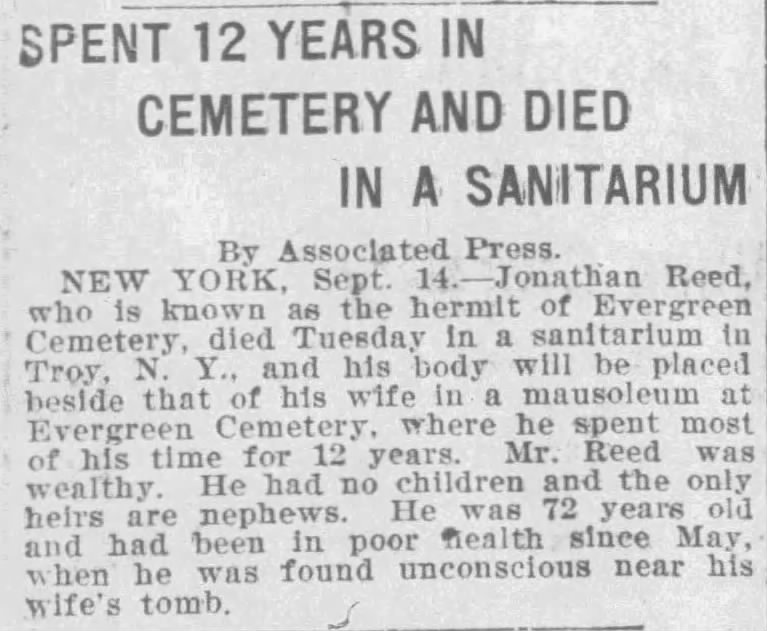
“Spent 12 Years in Cemetery and Died in a Sanitarium.”
Image courtesy of The Buffalo Times via Newspapers.com
IMAGE LINK
CITATIONS:
[1] Buffalo Sunday News, “Man Has Lived Ten Years In Wife’s Tomb And Vows He Will Never Leave Her Side,” The Buffalo Sunday News, October 18, 1903, 19.
[2] Brooklyn Daily Eagle, “Jonathan Reed Stricken In Tomb Where He Lived,” The Brooklyn Daily Eagle, March 23, 1905, 1.
[3] New York Times, “Found, Near Death, In His Wife’s Tomb,” The New York Times, March 24, 1905, 1.
 The Ghastly Historian
One response to “9/6/2023: Hermit of the Tomb”
[…] has been on a bit of a break, but is back with a new Ghastly History blog post! Check it out here. It details the story of Jonathan Reed – the man who lived in a tomb. More exciting stuff is on […]
LikeLike