
RISE OF THE FOX SISTERS
During the early 19th century, the Second Great Awakening produced many Protestant religious reform movements throughout the burned-over district of upstate New York. On March 31, 1848, Margaret and Kate Fox of Hydesville, New York, allegedly had their first supernatural experience. Through an exchange of rapping noises, they made contact with the spirit of a murdered salesman whose body was presumed by the girls to be buried in the basement of their home. An excavation of the Fox family basement revealed no human remains. A statement signed by William Duesler, a neighbor, in April 1848, confirms this: “‘There was some digging in the cellar on Saturday night. They dug until they came to water, and then gave it up. […] However, some insisted on digging at this time, and dug accordingly, but with no success.’”[1]
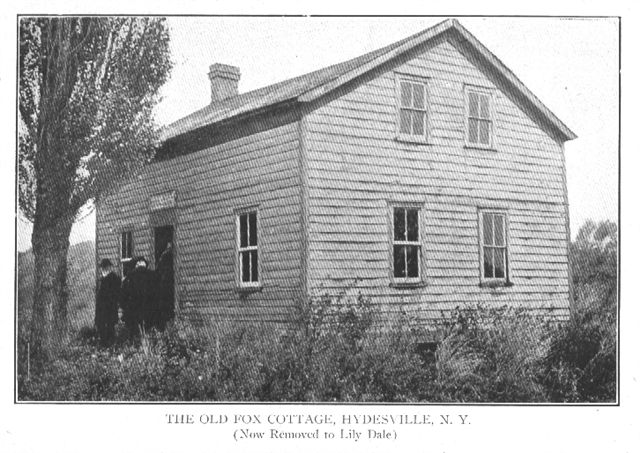
Image courtesy of the National Spiritualist Association of Churches.
IMAGE LINK.
However, the firestorm among the neighbors within the town and the press could not be extinguished by this time. These strange events, termed “The Rochester Knockings” by many of the news agencies of the time, would give birth to the religious movement known as Spiritualism.[2] Spiritualism is a religion based on the belief that after death, the soul lives on in the afterlife. Spiritualists believed that by employing various methods, the dead could be contacted from the beyond and interact with the living. For the girls, twelve and fifteen at the time, these events would begin their extraordinary rise to celebrity status for the next four decades.
Margaret and Kate Fox’s rise was primarily facilitated by the press and the sensational way they reported the claimed supernatural activity in 1848. An article printed in the Buffalo Weekly Republic on May 9, 1848, ghoulishly asserted that the ghost told the sisters that “[…] the body it once inhabited was that of a pedlar; that it was 31 years of age, and was murdered about four years since by the then occupant of the house, by having its throat cut with a butcher knife […].”[3] Many articles with similar chilling accounts of the events would be printed around the United States and abroad, perpetually linking the Fox sisters with the Spiritualist movement. Another contributing factor to the rise of Margaret and Kate was their older sister Leah Fox Fish. After recognizing and – as many scholars believe, exploiting – the popularity of her sisters, Leah would essentially become Margaret and Kate’s manager. In the early years, she would book séances from Rochester to New York City. These séances were attended by many citizens of the upper class, including the founder of the New York Tribune, U.S. House Representative, and 1872 presidential candidate Horace Greeley.[4]
A fascinating early account of one of the sisters’ séances was written by a Congressional minister named Lemuel Clark of Westford, New York, who was visiting friends in Rochester in the summer of 1848. His friends, the Lyman Grangers, particularly Mrs. Granger, were very close confidants to Leah Fox Fish. Leah brought the sisters to Rochester in June to live with her at her home, where she resided with her first husband at 11 Mechanics Square.[5] The first of two séances that Clark wrote about took place just two months after “The Rochester Knockings” began. Initially a skeptic, Clark became a believer in the psychic abilities that the Fox sisters touted. In the New York History article “The Fox Sisters in Action: A Clergyman’s Account,” the authors write, “Clark took part in the séance determined to expose, but became convinced that those in the room had in fact communicated with the spirits of the dead.”[6] Clark believed that spirit communication was possible through the sisters and wrote, “So, not understand that I was converted to the Spirit faith.”[7]
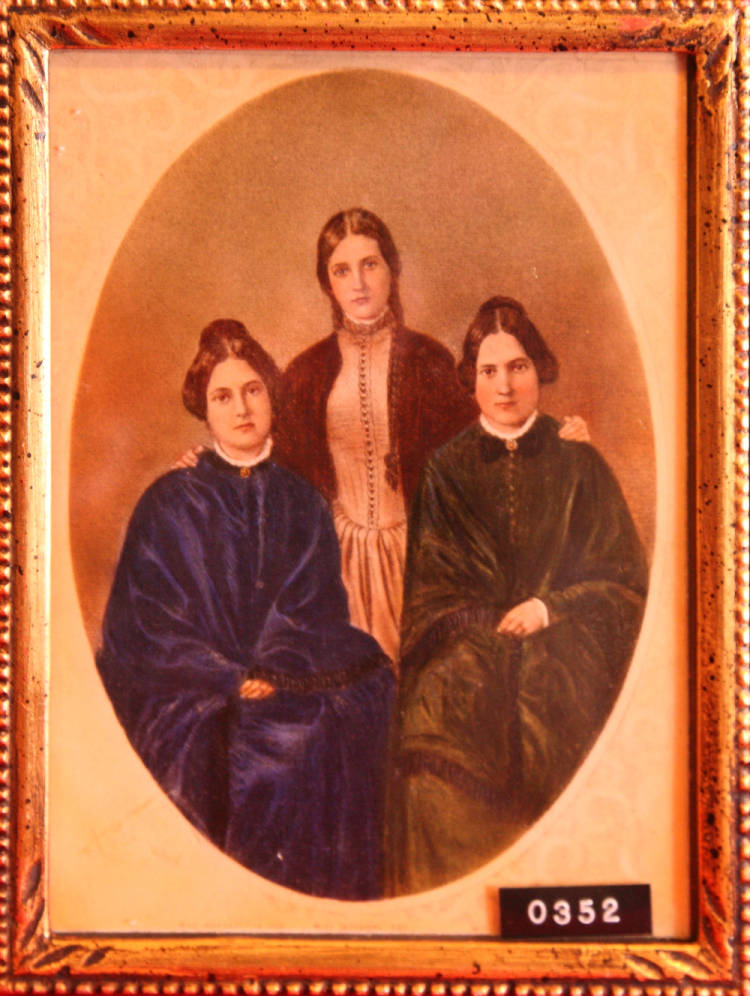
Image courtesy of Hett Art Gallery and Museum at Camp Chesterfield via IUPUI University Library and Indiana Memory.
IMAGE LINK.
CITATIONS:
[1] Rochester Knockings! Discovery and Explanation of the Source of the Phenomena Generally Known as the Rochester Knockings (Buffalo: George H. Derby and Co., Publishing, 1851), 22.
[2] John Townsend Trowbridge, “Early Investigations in Spiritualism,” The North American Review 188, no. 635 (1908): 526.
[3] Buffalo Weekly Republic, “The Ghost of Ganargwa – ‘Murder Most Foul!’,” Buffalo Weekly Republic, May 9, 1848, 1.
[4] Robert Sieber, Kathy Peterson, Marjorie Searl, and Lemuel Clark, “The Fox Sisters in Action: A Clergyman’s Account,” New York History 55, no. 3 (1974): 301.
[5] Ann Leah Underhill, The Missing Link in Modern Spiritualism (New York: Thomas R. Knox & Co., 1885), 32-34.
[6] Sieber, Peterson, Searl, and Clark, “The Fox Sisters in Action: A Clergyman’s Account,” 302.
[7] Sieber, Peterson, Searl, and Clark, “The Fox Sisters in Action: A Clergyman’s Account,” 316.


One response to “6/10/2023: Rise of the Fox Sisters”
[…] History blog. This post focuses on the early years of infamous Fox sisters. You can check it out here. I hope you enjoy, and another ghastly post will be up next […]
LikeLike